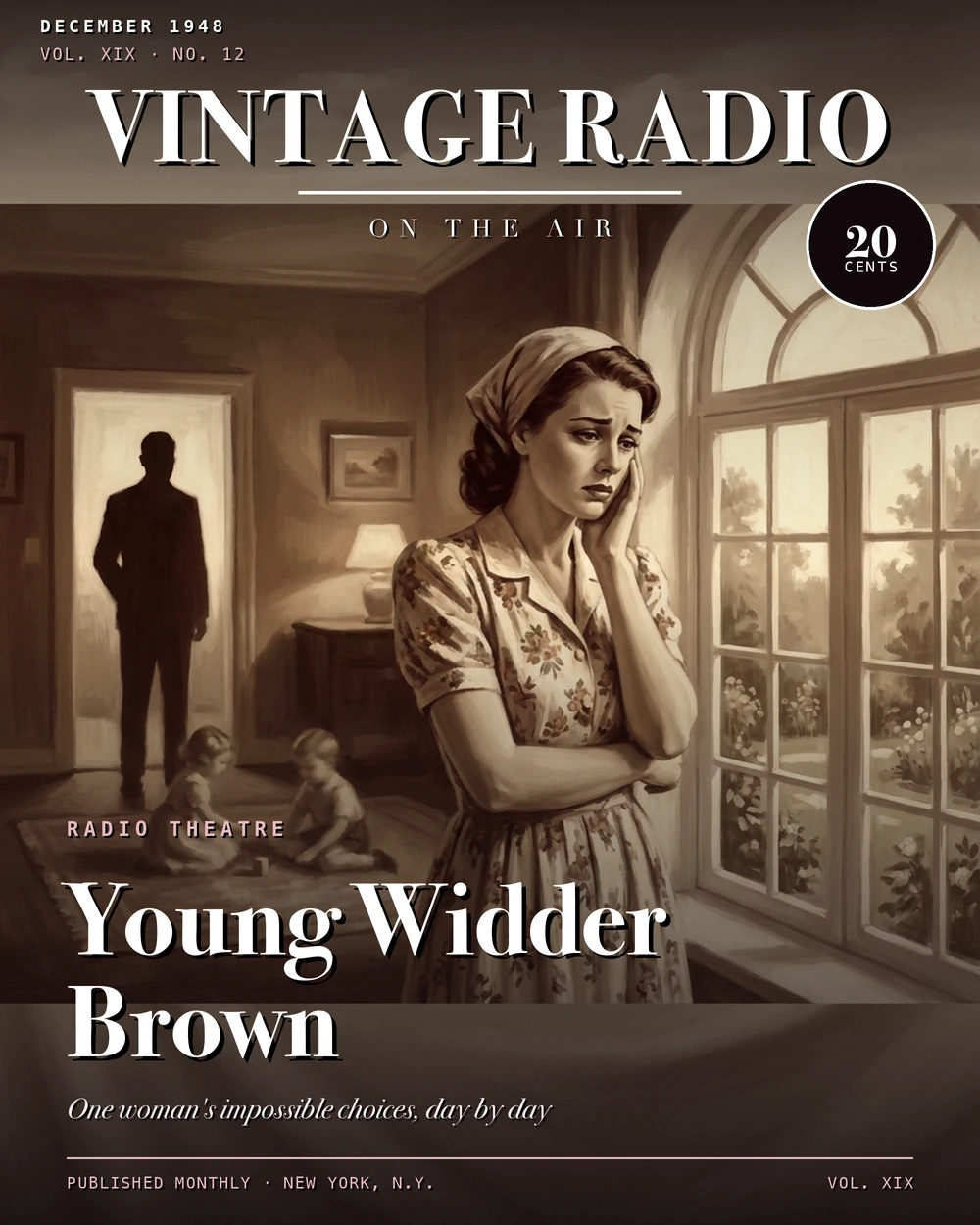
Young Widder Brown
The Central Conflict That Kept It Running
What held Young Widder Brown together for eighteen years — June 6, 1938, to June 22, 1956 — was a single, plain dramatic question: can Ellen Brown give herself to the man she loves without failing the two children who depend on her? The show opened with a billing that laid out the terms with no pretense: "the dramatic story of a very human mother's duty to her children, in conflict with the dictates of her heart." Later seasons streamlined that to "the age-old conflict between a mother's duty and a woman's heart." The language got shorter; the problem never got easier.
Ellen ran a tearoom in Simpsonville, West Virginia, raising her daughter Janey and son Mark on her own. Radio Guide noted in 1940 that she was successful enough at making a living — the tearoom stayed open — but that she was chronically alone. That loneliness was the engine. She was written as still in her early thirties across the entire run of the show, perpetually on the edge of happiness, perpetually pulled back. Hooper ratings held steady in the 8s throughout the serial's life, which made it one of daytime NBC's consistently top-rated programs and a serious competitor to three other Hummert properties: Stella Dallas, Backstage Wife, and The Romance of Helen Trent.
The Two Men in Ellen's Life
The love-triangle architecture that ran beneath eighteen years of plot came in two layers. Peter Turner — played by Clayton "Bud" Collyer — was the idealistic humanitarian Ellen loved first. He established a clinic for the poor people of the Smoky Ridge hill country, which told you everything about his character. The problem was Joyce Burton, a wealthy, spoiled woman who tricked Peter into marrying her. Joyce then suffered a mental collapse, and doctors made clear that if Peter left, she might never recover. Ellen was the one who told him to stay. That sacrifice set the pattern for what the show did over and over: Ellen made the honorable choice and paid for it in loneliness.
Then came Anthony Loring, played by Ned Wever, who in many ways defined the serial's second half. The show's own billing compared him to Gil Whitney from The Romance of Helen Trent — another suitor of implausible stamina who kept coming back regardless of what the plot threw at him. Anthony pursued Ellen across two full decades of storylines. He believed she had died in a plane crash; she had actually lost her memory and was being held in a lonely mountain hideaway by a man named David Blake. In the early 1950s, Anthony chose to believe a lie, cast Ellen out of his life, and turned to a woman named Millicent for consolation — and then was tricked into marrying her. On the rebound, Ellen agreed to marry a man named Michael Forsythe. Anthony eventually learned of Millicent's deceit and came back. In 1955, Millicent was murdered, Anthony was the prime suspect, and the real killer turned out to be Ivan Mansfield, a treacherous artist Millicent had hired to break up the Ellen-Anthony romance. Millicent left a will offering Ellen $250,000 on the condition that she never marry Anthony. The question of that will lingered until the last Friday of the show's final week.
The final broadcast, June 22, 1956, ended with Anthony asking "Will you marry me, Ellen?" and Ellen answering "Yes, I will, Anthony!" Eighteen years of obstacles, and that was the resolution.
The Plots That Sustained It
Newsweek took stock of the show's devices when it went off the air and turned up quite a list: false accusation of murder, amnesia, broken bones, and addiction to a "powder of forgetfulness" slipped into Ellen's nonalcoholic drink by an unscrupulous painter. There was also blindness brought on by an allergy to chocolate cake — until a cake-flour cosponsor complained, at which point that particular affliction was quietly written out. One storyline sent Ellen to a surgeon; the only doctor capable of saving her suffered a stroke while on his way to perform the operation. A character named Maria Hawkins spread vicious gossip about Ellen and organized a boycott of the tearoom. The accumulated crises had their own internal logic: each one delayed the marriage and justified another chapter.
The show was created and produced by Frank and Anne Hummert, the most prolific team in American soap opera history. At their peak, through their company Air Features, Inc. (later Hummert Radio Features), they had eighteen separate 15-minute serials on the air simultaneously, producing ninety original episodes per week. By 1939, their programs were responsible for more than half the advertising revenues generated by daytime radio. Anne Hummert drove the creative side, generating plot synopses that were sent by mail to a staff of "dialoguers" — writers who turned her outlines into full scripts without ever meeting her or Frank in person. Actress Mary Jane Higby put it plainly: "Unquestionably, they had a profound influence on the whole literature of soap opera. They, more than anyone else, determined the shape it took."
The Cast
Florence Freeman — born July 29, 1911, in New York City — played Ellen Brown from the premiere in 1938 through 1954, a tenure of sixteen of the show's eighteen years. She had come to radio after a dare: a friend challenged her in 1933 to prove she could make it as a radio actress, and she walked into WOKO in Albany, New York, and got hired. Before Young Widder Brown, she had attended Wells College (where she was Campus Queen), the New York State College for Teachers, and Columbia University, and had worked as an English teacher. The industry knew her as a "soap opera queen." Wendy Drew took over the role in 1954, and Millicent Brower stepped in for the serial's final days. Freeman died April 25, 2000, aged 88, in Grant Park, Illinois.
Ned Wever joined the cast as Anthony Loring in 1941 and stayed through the finale in 1956. His background was unusually varied: he had appeared on Broadway in The Second Little Show in 1930 and The Grab Bag in 1924, graduated from Princeton (where he was president of the Triangle Club), joined ASCAP in 1933, and composed songs including "Spellbound" and "Trust in Me" for productions featuring Billy Rose and Ed Wynn. Historian Garyn G. Roberts identified his most famous radio role as Bulldog Drummond, though Anthony Loring ran considerably longer. After Young Widder Brown, Wever racked up more than seventy television appearances, including Alfred Hitchcock Presents, Bonanza, and Perry Mason. He died May 6, 1984, in Laguna Hills, California.
Bud Collyer, who played Peter Turner, came from a legal background — he had attended Fordham University law school before calculating that a month's radio work paid more than a year of clerking and making his choice accordingly. By 1940 he was a familiar voice on all three major networks, and he is best remembered for voicing Superman and Clark Kent on The Adventures of Superman on Mutual, using different vocal registers to distinguish the two characters. He later served as national president of the American Federation of Radio Artists from 1948 to 1950 and received a star on the Hollywood Walk of Fame in the radio category on February 8, 1960. After his radio years, he became one of television's first prominent game show hosts — Beat the Clock and To Tell the Truth.
Marilyn Erskine, who played daughter Janey Brown from 1938 to 1956, had started performing at age three on a radio station in Buffalo, New York. She appeared simultaneously in multiple Hummert serials throughout the run — Lora Lawton and The Romance of Helen Trent among them — and also built a film career that included Westward the Women (1951), Above and Beyond (1952), and The Eddie Cantor Story (1953). Other recurring cast included Ethel Remey, Riza Royce, and Kay Strozzi in the role of Anthony's scheming sister Victoria Loring; House Jameson, Eric Dressler, and Alexander Scourby as the middle-aged admirer Herbert Temple; and Bennett Kilpack and Tom Hoier as Uncle Josh, Ellen's oldest friend.
The Sponsor, the Announcer, and the Sound
Bayer Aspirin — through parent company Sterling Drugs — sponsored Young Widder Brown for every one of its eighteen years, an unusually consistent commercial relationship for any radio program of that length. The show opened each weekday with a thunderous organ theme, then settled into John Winters at the organ playing "In the Gloaming." George Ansbro announced the program from 1938 through 1956 and was so closely identified with it that radio historian Jim Cox later described him simply as "Young Widder Brown daytime serial narrator 1938–56." Ansbro had started at NBC in 1928 as a boy soprano, worked as an NBC page in 1931, and joined the announcing staff in 1934, succeeding Bert Parks as New York's youngest network staff announcer. When NBC Blue separated into ABC, he moved to the new network but was permitted to continue announcing NBC programs including this one. He retired from ABC on January 14, 1990 — his 75th birthday — after 58 years, 3 months, and 12 days of service, a record tenure. He wrote a memoir, I Have a Lady in the Balcony: Memoirs of a Broadcaster in Radio and Television (McFarland, 1999), with a foreword by Leonard Maltin, and died November 5, 2011, aged 96.
Directors over the run included Martha Atwell, Richard Leonard, and Ed Slattery. The time slot moved as the years passed: 11:30 a.m. from 1938 to 1939, then 4:45 until 1951, then 4:30 until 1955, then 4:15 for the final year. The late-afternoon placement in particular made it part of the daily rhythm of listeners who had the radio on as the afternoon wound down — a different kind of attention than morning programs commanded, and one the show's slow-burn storylines were well suited to.